Home›Blog›What is a project in project management, and what is not
FundamentalsBeginner
Published September 6, 2026 · By Vincent KENNEL
What is a project in project management, and what is not
Five referentials define project, and they do not quite define the same object. What they agree on, what separates a project from an operation, and where a piece of work stops being one at all.
In brief
A project is a bounded piece of work: coordinated and controlled activities, with start and finish dates, undertaken to meet specified requirements under constraints of time, cost and resources (ECSS-S-ST-00-01C Rev.1, 2.3.177). Work that repeats and is meant to continue is an operation, not a project.
Project covers a bill going through Parliament, a personal intention, and a ten-year industrial programme. That spread is not a vocabulary problem, it is a management one: calling something a project no longer says which rules apply to it. The standards define the term for exactly that reason, and they do not all define quite the same object.
What a project is, in the standards' own words
The four elements of one definition
One definition gathers everything into a single sentence. It comes from the European space standards, and it is the only one in wide circulation that names all four elements at once: a project is a "set of coordinated and controlled activities with start and finish dates, undertaken to achieve an objective conforming to specific requirements, including constraints of time, cost and resources" (ECSS-S-ST-00-01C Rev.1, 2023, entry 2.3.177).
Each of the four does work.
Coordinated and controlled. A project is an object of management by construction, not by accident. Take a set of work bounded by dates and given a budget, but that nobody coordinates and nobody controls: that is not a project, it is a funded list of tasks. This is the element most other definitions leave out, which is why this one is worth starting from.
Start and finish dates. The work is bounded at both ends, and that boundary is what the standards mean by temporary. What ends is the engagement, not necessarily what the engagement produced.
An objective conforming to specific requirements. Not an intention, a specified result. The IPMA says the same thing in different words, "agreed deliverables within predefined requirements and constraints" (IPMA Individual Competence Baseline (ICB) 4.0, 2015, p. 36), and the French normative text speaks of deliverables conforming to specific requirements (NF ISO 21500:2012, art. 3.2). Specified and agreed means opposable: two parties can hold each other to it.
Constraints of time, cost and resources. These are conditions the project carries, not tests it passes. Work does not become a project because money is tight. It is a project that happens to be constrained, and the constraints belong to the definition rather than to the diagnosis.
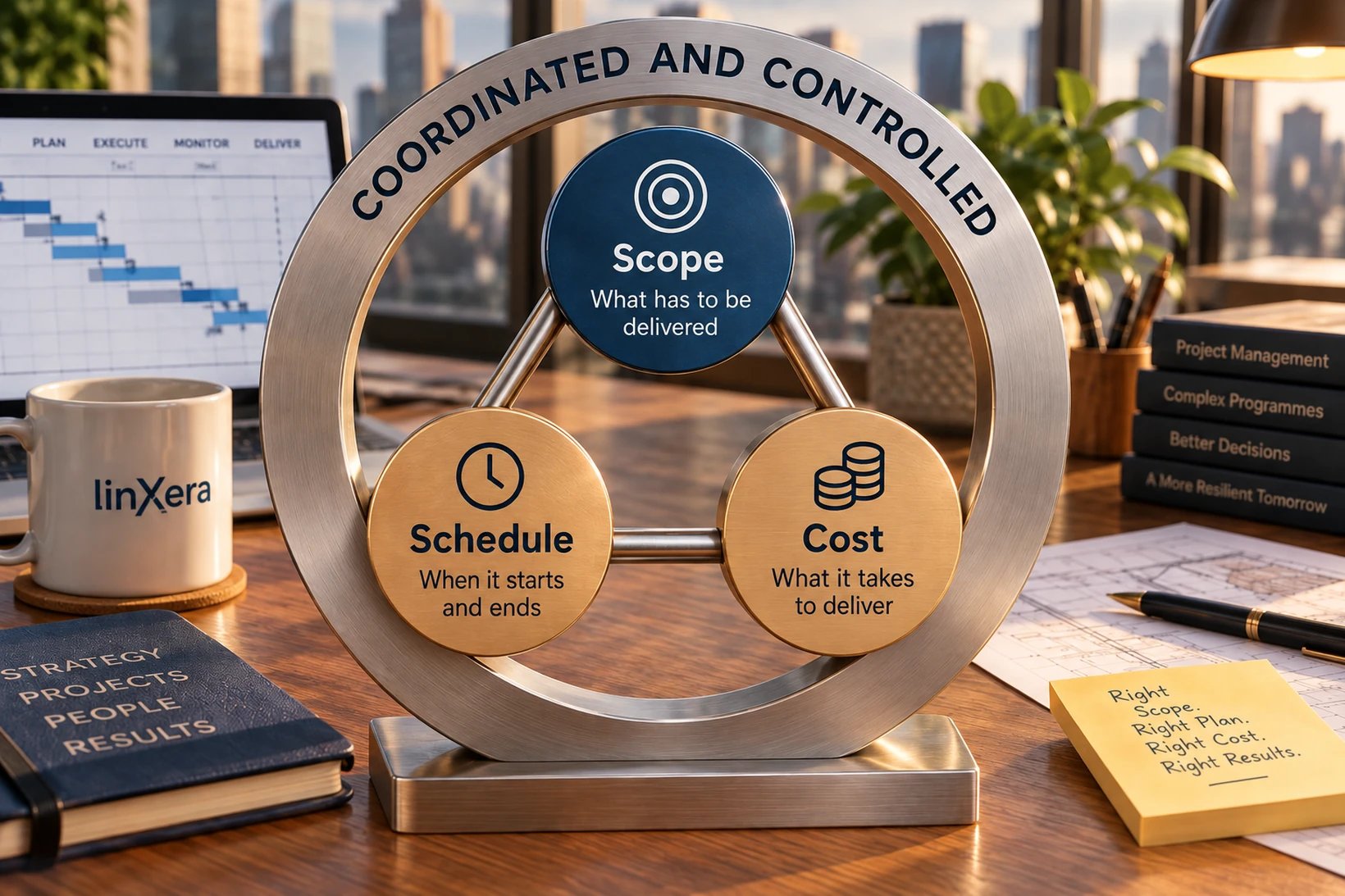
The figure below gathers the same clause under shorter names: Scope for the objective and its requirements, Schedule for the dates and the time the work is given, Cost for what it takes to deliver, resources included, all three enclosed by Coordinated and controlled.
The four elements of the definition, and what holds them together.
What the other referentials say
Five referentials, five sentences, and they do not carve out the same object.
The one most readers have already met is the PMI's: "A project is a temporary endeavor undertaken to create a unique product, service, or result" (PMBOK Guide, Third Edition, 2004). The sentence has not moved since, and it is reproduced word for word in the editions that followed (PMBOK Guide, 6th Edition, 2017; PMBOK Guide, 7th Edition, 2021). That stability is mechanical rather than editorial: PMI standards committees "will be required to use the Lexicon definitions without modification" (PMI Lexicon of Project Management Terms, 2012).
The shortest and most recent is the ISO's. NF ISO 21502:2021 defines a project as a temporary effort undertaken to achieve one or more defined objectives (art. 3.20, our rendering of the French text, "effort temporaire pour atteindre un ou plusieurs objectifs définis"). The standard says what it changed: the words created to produce agreed deliverables were replaced by to achieve one or more defined objectives. The deliverable gave way to the objective.
PRINCE2 defines something else altogether: "A temporary organization that is created for the purpose of delivering one or more business products according to an agreed business case" (PRINCE2 7, 2023, p. 5). The APM stays with the effort: "A unique, transient endeavour undertaken to bring about change and to achieve planned objectives" (APM Glossary, archive snapshot of 19 August 2026).
So the genus differs. For PRINCE2 7 a project is an organisation; for the PMI, the ISO, the IPMA, the APM and the ECSS it is an effort or a process. The split is older than any of these texts: writing in 1959, Paul O. Gaddis already described a project as "an organization unit dedicated to the attainment of a goal" (Gaddis, The Project Manager, HBR, 1959).
One thing to carry forward before moving on. Schedule, scope and cost are constraints, and constraints hold each other: keep the date and something in the scope or the cost gives way, widen the scope and the other two move with it. That is an observation about practice rather than a clause in any of the definitions above, and the texts that name the interdependence do it about contracts rather than about the object, SAFe 6.0 calling it "the iron triangle of fixed scope, schedule, and cost" (SAFe, Agile Contracts, SAFe 6.0). Which of the three should give, and on what signal, is a subject of its own and not this one.
Temporary does not mean short. The standard glosses its own word: "Temporary does not necessarily mean short in duration; many projects last for several years" (PMBOK Guide, 1996 Edition, art. 1.2.1). And what is temporary is the effort, not what it leaves behind: "Projects are temporary, but their deliverables may exist beyond the end of the project" (PMBOK Guide, 6th Edition, 2017, art. 1.2.1). A ten-year programme is a project. The motorway it built is not.
How to tell whether what you run is a project
What is not a project: an operation
The contrast with operations is the oldest test in the discipline, and it has moved.
NF ISO 21500:2012 set it out as two columns (art. 3.7): operations are carried out by relatively stable teams through continuous and repetitive processes, projects by temporary teams producing unique deliverables. Nine years later the criterion had changed. NF ISO 21502:2021 drops the uniqueness of the deliverable from the contrast and puts the maintenance or addition of value or capability in its place (art. 4.1.2). The shift is larger than it looks: uniqueness is a property of the output, maintaining value is a purpose, and an organisation sorts its work differently depending on which one it applies.
The PMI stated the same contrast by finality: "The purpose of a project is to attain its objective and then terminate. Conversely, the objective of an ongoing operation is to sustain the business" (PMBOK Guide, Third Edition, 2004, art. 1.2.2).
The sharpest formulation of all is a negative one, and it is French. The 1991 AFNOR fascicule writes that a project is not a production operation for which a model exists that can be reproduced indefinitely (FD X50-105, August 1991, p. 5, our rendering). Reproducibility, not size, is what puts work on the other side of the line.
The test that applies tomorrow morning. At the end, does the team dissolve because the objective has been met, or does it take on a new set of objectives and carry on? The second case is what the standard describes as non-project work: such undertakings "adopt a new set of objectives and continue to work" (PMBOK Guide, 1996 Edition, art. 1.2.1). The question is ours, the observation is the standard's.
What stops being one: continuous flow
Some organisations have stopped running work as projects, and they say so plainly.
SAFe 6.0 names the artefact that replaces the project cycle: "The Continuous Delivery Pipeline (CDP) represents the workflows, activities, and automation needed to guide new functionality from ideation to an on-demand release of value" (SAFe, Continuous Delivery Pipeline, SAFe 6.0). It has four parts: Continuous Exploration, Continuous Integration, Continuous Deployment, and Release on Demand.
The framework is explicit about what it is leaving behind: "Achieving continuous flow requires a new way of working that eliminates the traditional start-stop-start project cycle and the waterfall phase gates that hinder flow" (SAFe, Principle 6, Make Value Flow without Interruptions, SAFe 6.0). And it follows through on the money: "Lean Budgets is a financial governance approach that funds value streams instead of projects" (the official SAFe glossary, SAFe 6.0).
What identifies this situation is not the vocabulary, it is the funding and the team: durable funding, a durable team, and a scope re-prioritised continuously instead of agreed once. At that point the word project is being used out of habit.
The two families of projects
Once the object is clear, the practical question is which kind of project is in front of you, because the two are managed on different assumptions.
The normative split is recent, and it comes from the ISO. NF ISO 21502:2021 states that projects can be undertaken from two angles (art. 4.2.3): that of the client or sponsoring organisation, and that of the supplier or provider. It adds the notion of a revenue-generating project, and one rule worth remembering: the supplier's project scope is part of the client's project scope.
The older French formulation says the same thing from the other end, and it names the two families. The AFITEP and AFNOR dictionary distinguishes the projet ouvrage, whose purpose is a result valued for itself, from the projet produit, whose purpose is to develop something that will then be produced repeatedly for a market. The first is also called projet d'ingénierie or projet client, because it is meant for a single client; the second is called projet de développement or projet marché (Dictionnaire de management de projet, 3e édition, 1996, introduction, pp. XIII to XIV).
What the family changes, at the level of situating the work rather than steering it: on a client project the buyer is identified and the scope is agreed with them; on a market project the client is a market, and the scope is decided internally.
Programme and portfolio are not projects scaled up. A programme is a group of programme components managed in a coordinated way in order to realise benefits; a portfolio is a set of portfolio components grouped to facilitate their management towards strategic objectives (NF ISO 21502:2021, art. 3.18 and art. 3.15). Both are defined in their own right, and both are a subject of their own.
Why the management sense of the word is so recent
The word is old. Its management sense is not, and it did not enter through the language.
English dictionaries place the first appearance of project around the turn of the fifteenth century and do not agree on the date: the Online Etymology Dictionary gives around 1400, in the sense of "a plan, draft, scheme, design", and Merriam-Webster gives the fifteenth century (both consulted 4 September 2026).
Everything the discipline rests on appears in a single stretch at the end of the 1950s. The critical path method is published at the Eastern Joint Computer Conference of December 1 to 3, 1959 (Kelley and Walker, Critical-Path Planning and Scheduling, 1959). PERT is published in Operations Research the same autumn, for the Polaris programme (Malcolm, Roseboom, Clark and Fazar, Application of a Technique for Research and Development Program Evaluation, 1959). Gaddis describes the project manager in the Harvard Business Review of May and June 1959 as a function so new that its name is not settled: "Although he goes by many titles, the one most generally used is project manager". The PMI holds its first formal meeting ten years later, on October 3, 1969 (PMI, Our Legacy, consulted 19 August 2026).
Where the sense was actually written down is a separate question, and there is one documented case. In August 1991 an AFNOR fascicule opens on the word itself, in bold: "Quand les mots changent d'usage, ils changent aussi de sens. Le mot Projet est de ceux qui en ont le plus." When words change their use they change their meaning too, and project is one of those that has changed most. The text then sets aside the two traditional senses, the intention and the first draft, before stating its own (FD X50-105, August 1991, art. 3, p. 4). A standards body, not a dictionary, is what put the management sense on the record.
As for the phrase project management itself, we found no primary source dating its first appearance in print. If the word feels vague, that is a property of the word rather than a gap in the reader.
In short
The useful question is not what to call the work, it is which of the four elements it actually has. Two of them are quick to check: the dates and the constraints. The two that decide are the other pair, whether the objective is specified and agreed, and whether anyone is coordinating and controlling. Work that fails either one is being run as a project in name while behaving as something else, and the first move is to say aloud which of the two is missing. Once that is settled, the family follows: an identified buyer and a scope agreed with them point to a client project, a scope decided internally points to a market one, and the two are not steered on the same assumptions.
Stop guessing. See the real impact.
Frequently asked questions
Q.Can a project have more than one deliverable?
Yes, and that is the normal case. In the English definitions, unique qualifies the project rather than the number of things it produces: it means unlike other work, not one only. PRINCE2 7 writes one or more business products, and the PMBOK Guide, Third Edition, 2004 writes unique deliverables in the plural.
Q.Which of these definitions should I use?
The one your contract, your client or your organisation's referential names. It is a question of which text you are answerable to, not of which definition is better. If none binds you, the choice is free, provided one project does not switch referential halfway through.
Q.Is working in agile still working on a project?
In the referentials, yes: an agile approach is a delivery approach used inside a project, and NF ISO 21502:2021 lists agile among them. Work leaves the project form only when the organisation changes how it funds and staffs it, which is what SAFe 6.0 describes.
Q.Does it matter whether a referential calls a project an organisation or an effort?
It changes what the word names. For PRINCE2 7 the project is the temporary organisation itself, something set up and later closed down. For the PMI, the ISO, the IPMA, the APM and the ECSS it is the effort that such an organisation carries out. The difference is what is being named, not which reading is right.
References
AFNOR - FD X50-105 - Le management de projet, concepts - Fascicule de documentation, août 1991
AFNOR - NF ISO 21500:2012 - Lignes directrices sur le management de projet - Octobre 2012
AFNOR - NF ISO 21502:2021 - Recommandations sur le management de projet - Juin 2021
AFNOR, AFITEP - Dictionnaire de management de projet français-anglais-espagnol - 3e édition, 1996
INFORMS - D. G. Malcolm, J. H. Roseboom, C. E. Clark, W. Fazar - Application of a Technique for Research and Development Program Evaluation - vol. 7, no. 5, 1959