Workload & Cost Management
Project budget, time-phased cost breakdown, contingency reserves and cost allocation. Steering a spending curve, not a fixed envelope.
A project budget is not a sum, it is a curve. Its shape over time matters as much as its total: it reveals the real cost of the schedule, the health of the resource load plan, and the trajectory of cash outflows. In a project, every delay is paid in days × daily rate × team headcount (the dependency network holds the entire team hostage, so no one can be reassigned during the wait), material inflation compounds with the time drift, and starting work too early produces work built on decisions still in flux, which turns into rework when the decisions move. Good project cost management is therefore not about controlling an envelope: it is about steering a spending trajectory derived from a robust schedule.
A project budget is often presented as an envelope not to be exceeded. This view misses the essential: what determines the financial health of a project is not the total, it is the way spending flows through time, compares to the schedule, and is allocated to the right categories. This hub treats project cost management as a trajectory to steer, not as a sum to monitor.
Get started
Beginner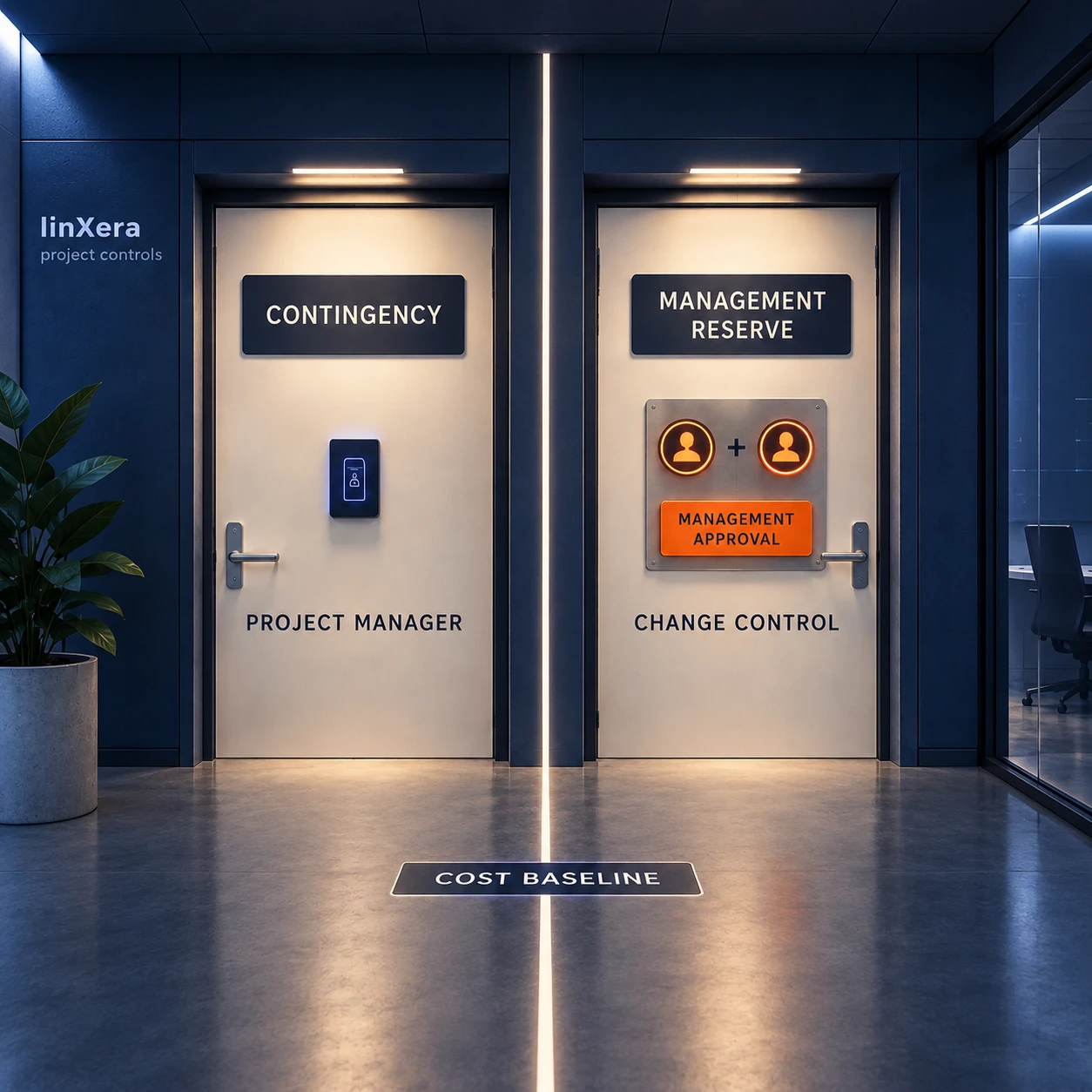
Contingency reserve vs management reserve: where the line runs

Cost breakdown structure: what it is, and what the WBS does not carry
Put into practice
IntermediatePublication planned soon.
Publication planned soon.
Go deeper
AdvancedPublication planned soon.
Publication planned soon.
Your questions, our anchors
Q.How do you structure the budget of a project?
A well-structured project budget distinguishes four types of envelopes, each responding to a different nature of uncertainty. This distinction, formalized notably in the AACE International Recommended Practices (RP 42R-08 on estimate classes, RP 44R-08 on contingency determination) and in the PMBOK Guide, is more than an accounting convention: it is the condition of an honest reading of the project's financial exposure.
The base cost covers all the costs necessary to deliver the validated scope, without margin: personnel, materials, services, equipment. It is established from the resource load plan of the operational schedule. It is the hardest figure to defend, because the instinct is to bake margins into it for protection, which then masks the real exposure.
The contingency reserve covers the identified risks from the risk register: probable events with quantifiable impact. It is sized risk by risk, traced, and its use is justified by the occurrence of the corresponding risk. It is treated in detail in the Risk & opportunity management hub.
The management reserve covers uncertainties not identified at project approval: the unknown unknowns. It is sized against the maturity of the project (lower for a repetitive project, higher for an exploratory project at low TRL). Unlike the contingency reserve, it is not tied to specific events, and its use requires an explicit sponsor decision.
The change budget covers scope modifications decided after initial approval: new features requested, scope extensions, adaptations imposed by context. It is often held separately, with a dedicated validation process, because its mechanics differ from the previous three: it funds addition, not protection against uncertainty.
Confusing these four envelopes means losing the reading of the project's financial health. A base cost overrun signals an initial underestimation; heavy consumption of the contingency reserve signals that identified risks are materializing; mobilization of the management reserve signals that unknowns are appearing; a large change budget signals that the scope has moved. It is not the same story to tell the sponsor.
Q.How do you time-phase a project budget?
A project budget only has steerable value once time-phased. A total without a curve says nothing about the project's health at a given moment: you need to know how much should have been spent by that point, to compare with what has actually been spent, and to project the trajectory to completion.
This time-phased budget is not obtained by linearization. Distributing the budget uniformly between start date and end date is a methodological error that produces a reference curve with no link to operational reality. The right method is to start from the detailed operational schedule, build the resource load plan activity by activity, then translate that load plan into monthly spending. The resulting curve typically has an S shape: gradual ramp-up at start, high plateau in the production phase, ramp-down at the end. Any other shape deserves explanation.
Two effects make this time-phasing all the more critical in long projects. The first is the cost of delay: if the project slips, the budget drift is not neutral, it is directly equal to the team workload during the slippage period (days × daily rate × affected team members), without any possibility of reassigning the team during the wait because the dependency network holds the entire team hostage. The second is inflation: on multi-year projects, material and service prices rise, and that increase compounds with the time drift. A realistic time-phasing integrates both effects, not just the activity calendar.
This time-phased budget plays a dual role. On the forward-looking side, it enables the calculation of a credible EAC (Estimate at Completion), by projecting the actual trajectory against the expected trajectory. On the backward-looking side, it provides the reference against which S-curve indicators (from methods like EVM) take their meaning. Without time-phasing, these indicators can only produce a post-facto observation, without any predictive steering capability.
A complementary good practice is phase-by-phase budget release: rather than opening the entire envelope from the start, the organization releases tranches phase by phase, upon milestone achievement. This discipline prevents the invisible overconsumption of early phases (teams tend to consume what is available) and makes any early gap visible before it becomes irrecoverable.
Q.Which budget should a forecasted cost be allocated to?
In a project, the real financial question does not arise when the invoice arrives: it arises when a forecasted cost is identified in the schedule. At that moment, the arbitration is less about "how much does it cost" than about "which envelope does it go into".
Building the operational schedule produces a distribution of activities tied to deliverables or intermediate artifacts. Each activity requires resources, which constitutes a workload (load) translated into cost by applying the daily rate and material rates. The sum of the forecasted costs, time-phased, produces both the EAC (Estimate at Completion) to compare against the total budget, and the monthly spending profile to compare against the planned budget flow. What remains is to decide, for each cost, which envelope it belongs to.
Four allocation categories coexist, and the arbitration is not neutral.
On the base cost: the cost is planned within the initial scope, consistent with approval-stage estimates. It is the nominal case, the one that should mostly populate the operational schedule. Any allocation here adds to the project's current consumption and weighs on the EAC.
On the change budget: the cost results from a formally validated change request, that is, from a recognized and authorized scope modification. The allocation is legitimate but it signals that the scope has moved, an event to understand in its full context, which belongs to scope management.
On the contingency reserve: the cost materializes the occurrence of an identified risk from the register. The allocation is legitimate but it reflects the materialization of an anticipated uncertainty, and it consumes a dedicated reserve that will no longer be available for another risk.
Off-budget: none of the three previous categories accepts the cost. This is the critical situation: it reflects either an unanticipated unknown (mobilization of the management reserve, sponsor decision), or an uncontrolled drift that triggers a budget top-up request and an escalation.
The distribution of a project across these four categories is in itself a health indicator. A project where almost everything is allocated to the base cost is holding its course. A project where the change budget swells reflects failing scope management or an evolving context to be reintegrated into governance. A project that rapidly consumes its contingency reserve has either underestimated its risks or encountered a grouped materialization. A project where "off-budget" appears has crossed a threshold that requires a political decision, not just a technical one.